The Ideas That Stayed With Me
1. Childhood Wounds and the Patterns We Inherit
This was the section that cracked me open. LePera writes extensively about how our earliest relationships, particularly with our caregivers, create a kind of emotional blueprint that we carry into adulthood. She calls this our “conditioned self”: the version of us that learned, very early on, how to think, behave, and love in order to survive our environment.
What struck me was not the concept itself. Attachment theory isn’t new, but the way she made it personal. She explains that we tend to gravitate towards relational dynamics in adulthood that mirror the ones from our childhood, not because they’re healthy, but because they’re familiar. Our nervous systems are wired for familiarity, not functionality. That distinction alone was worth the price of the book.
Reading this, I began to see my own patterns with startling clarity: the way I’d unconsciously chosen relationships that confirmed my deepest insecurities, the way I’d interpreted emotional unavailability as something I needed to earn my way out of. These weren’t accidents. They were echoes of a much older story.
2. Self-Worth as a Practice, Not a Destination
One of the most quietly powerful shifts this book facilitated for me was around self-love. Not the Instagram version, the bubble baths and affirmations, but the real, unglamorous kind. The kind that involves sitting with uncomfortable truths about yourself and choosing to stay anyway.
LePera reframes self-worth not as something you arrive at, but something you practise daily. It’s in the small choices: honouring a boundary, speaking your truth, no longer abandoning yourself to keep the peace. She makes a compelling case that the love we so desperately seek externally is, in fact, a reflection of the love we haven’t yet learned to give ourselves.
This reframing changed something fundamental in how I approached my own healing. I stopped waiting for someone to make me feel worthy and started doing the slow, deliberate work of building that feeling from the inside out. It’s not poetic. It’s not instant. But it’s real.
3. The Nervous System – Where Healing Actually Lives
If the sections on childhood wounds were the intellectual revelation, the chapters on the nervous system were the embodied one. This is where LePera’s holistic approach truly distinguishes itself from conventional self-help.
She explains, with striking clarity, that healing is not purely a cognitive exercise. You cannot simply think your way into secure attachment. Our past hurts and unresolved traumas are stored not just in our minds, but in our bodies, in the nervous system that continues to react as though we are still in danger, even when we are safe. This is why we can understand our patterns intellectually and still find ourselves repeating them. The body hasn’t caught up with the mind.
LePera introduces practical tools for nervous system regulation: breathwork, body awareness exercises, and what she calls “heart coherence“, a practice rooted in research about cultivating feelings of compassion and safety within the body. These weren’t abstract ideas. They were things I could do, that day, in my living room. And they worked. Not dramatically, not overnight, but in the quiet, cumulative way that real healing tends to unfold.
This was perhaps the most paradigm-shifting element of the book for me: the understanding that my body had been keeping score long before my mind caught on, and that learning to regulate my nervous system was not a luxury or an add-on to the work, it was the work.
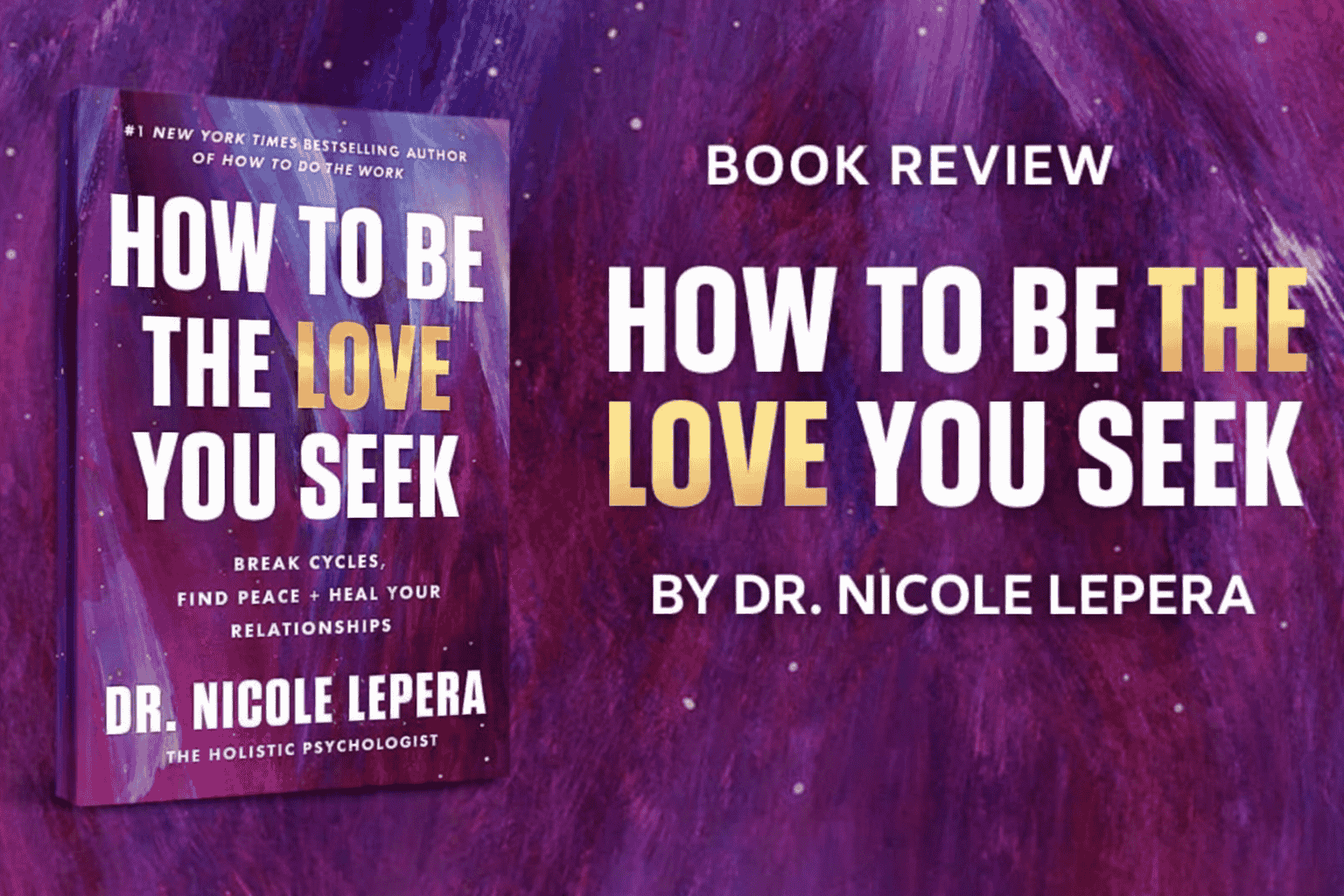
What Makes How to Be the Love You Seek Book Practical
This is not a book you passively consume. It’s filled with journal prompts, self-reflection exercises, guided meditations, andreal-life stories that ground the theory in lived experience. LePera doesn’t just tell you what’s wrong, she gives you a structured path to do something about it.
The book is organised to move you through stages: from understanding your conditioned self, to building body and emotional awareness, to practising heart-centred connection with others. Each chapter builds on the last. It asks you to pause, to write, to feel. If you engage with it fully, it becomes less of a book and more of a process.
For readers who want more than theory, who want something they can apply, this is where the book delivers.
Who Should Read This – And a Note of Honesty
If you are someone who finds yourself stuck in the same relational patterns, who feels a disconnect between what you know and what you do, who senses that the love you’ve been chasing has been misdirected, this book will speak to you. It’s written for cycle-breakers: people who are ready to stop inheriting their pain and start transforming it.
It’s also a book for anyone navigating the aftermath of difficult relationships, not just romantic ones.
That said, in the spirit of honesty: the book is long, and at times it can feel repetitive. Some concepts may feel familiar. And ideas like heart coherence may not resonate with everyone.
But here’s what I’d say: take what resonates and leave the rest. The core message, that healing your relationship with yourself is the prerequisite to healing your relationship with anyone else, is powerful enough to carry the entire book.
What How to Be the Love You Seek Book Meant to Me
I don’t write this review from a position of detachment. This book is close to my heart because it met me at a point where I was ready to do the work but didn’t know where to begin. It gave me language for things I had felt but couldn’t articulate.
It showed me that my patterns weren’t evidence of brokenness, they were evidence of a child who learned to survive and an adult who hadn’t yet learned to live differently.
It taught me that the nervous system holds the key to healing, that self-love is foundational, and that the love I’d been seeking externally would never feel enough until I learned to generate it within myself.
I won’t say this book fixed me. But it gave me a map. And for the first time, I felt like I was walking in the right direction.
Quick Book Overview on How to Be the Love You Seek