
For the longest time, I was convinced I was just not a morning person. I’d set my alarm for 6 am with genuine intentions, hit snooze four times, and eventually drag myself up at 8 am feeling guilty and already behind.
Does this scenario sound familiar to you?
What changed for me wasn’t willpower or motivation. It was understanding that waking up early isn’t something you force; it’s something you build.
Once I stopped treating it as a daily battle and started treating it as a habit with a solid foundation, the mornings started to feel different, less like something happening to me and more like something I was actually choosing.
In this blog, we’re going to talk about why waking up early is actually worth the effort, how to make it stick without misery, and the small evening and morning habits that make the whole thing sustainable.
Why Bother? The Real Benefits of Waking Up Early
Before we get into the how, it’s worth being honest about the why because “successful people wake up early” is not a good enough reason to change your entire sleep schedule. Here’s what actually shifts when you start your day earlier.
1. You Get Uninterrupted Time That’s Yours
The early morning hours, before messages start coming in and the day makes its demands, are the closest most of us will get to genuine quiet. No one needs anything from you yet. Your phone isn’t blowing up. That window of time is extraordinary for focused, distraction-free work, whether that’s writing, planning, exercising, or just thinking clearly before the noise begins.
For me, the 6–7 am hour became the one part of the day that felt mine fully. It changed the entire texture of my mornings.
2. It Creates Space for Self-Care
When you’re rushing from alarm to commute with no buffer, self-care is the first thing that disappears. Waking up early gives you time for the things that actually sustain you: exercise, a proper breakfast, a few minutes of journaling, or just drinking your coffee while it’s still hot. These aren’t luxuries. They’re what make the rest of the day manageable.
3. It Supports Better Mental Health
A chaotic morning sets a chaotic tone. When you wake up with time to ease into the day rather than sprint into it, you’re starting from a calmer baseline. Over time, a consistent morning routine has a real impact on stress levels and anxiety because you’re no longer beginning every day already behind.
4. It Regulates Your Sleep
This one surprises people. Waking up at a consistent time even on weekends is actually one of the most effective things you can do for sleep quality. Your body has a natural circadian rhythm, and consistency is what keeps it running well. Better sleep quality means you wake up feeling more rested, which makes waking up early feel less like punishment.
5. It Improves How You Manage Your Day
When you have a clear, calm hour before the demands begin, you can actually think about your priorities. You can review what matters, set a clear intention for the day, and make decisions before decision fatigue sets in. That kind of intentional start makes a measurable difference.
Why It’s Hard to Wake Up Early (And Why It’s Not Your Fault)
If you’ve tried and failed to become a morning person, I want to say this clearly: the problem is rarely a lack of discipline. Most of the time it comes down to a few fixable things.
1. Your body clock might genuinely be set later. Chronotype, your natural tendency toward mornings or evenings, is partly genetic. Night owls aren’t lazy. Their circadian rhythm is simply calibrated differently. That can be gradually shifted, but it takes time and patience, not just an earlier alarm.
2. Your evenings are working against your mornings. Staying on your phone until midnight, eating late, or having inconsistent bedtimes means your body never has a reliable sleep signal. You can’t expect your body to spring awake at 6 if you’ve been sending it mixed signals every night.
3. You’re trying to shift too much too fast. Jumping from an 8 am wake-up to a 5 am alarm overnight is a setup for failure. The body resists abrupt change.
How to Wake Up Early: A Practical Guide That Actually Works
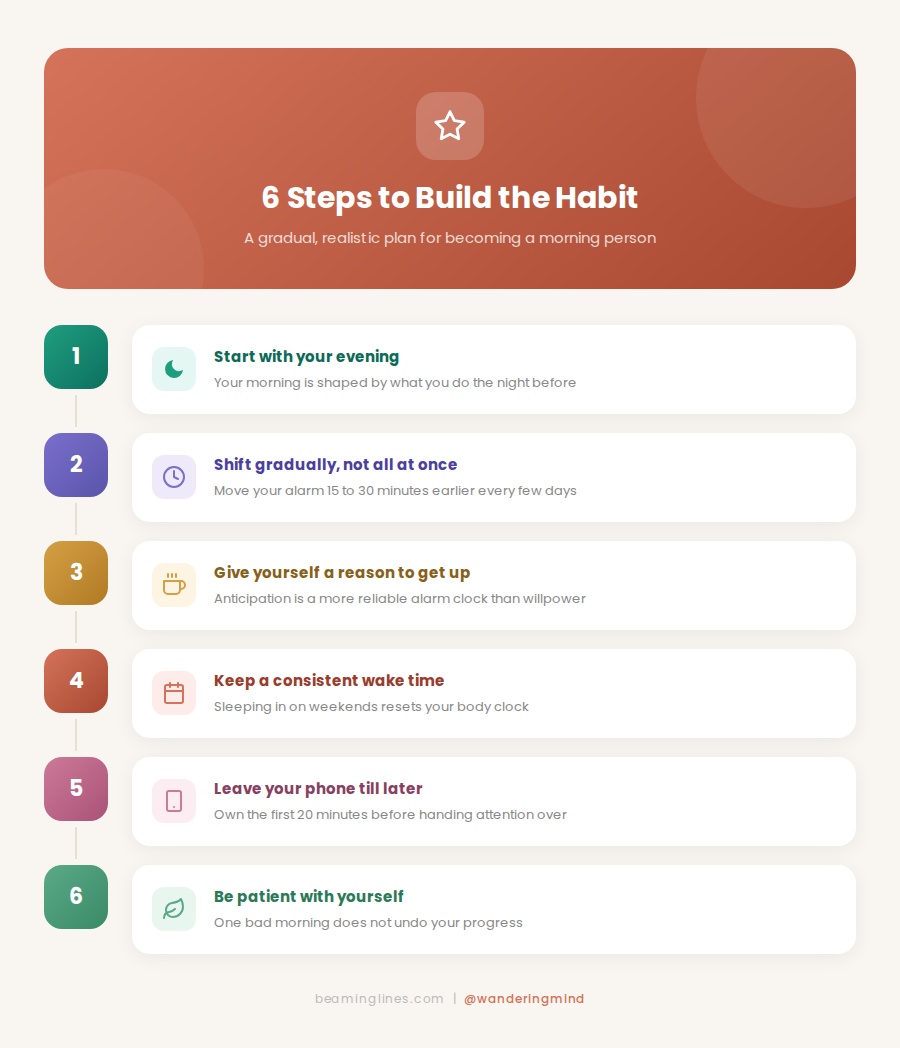
1. Start With Your Evening, Not Your Morning
This is the step most people skip, and it’s the most important one. How you wake up is determined the night before. A winding-down routine that signals to your body that sleep is coming is worth more than any alarm strategy.
A few things that help:
- Dim your lights about an hour before bed; bright overhead lighting keeps your brain in “daytime mode”
- Put your phone face-down or in another room at least 30 minutes before sleep
- Avoid heavy meals or caffeine after 6 pm
- Do something genuinely relaxing: reading, stretching, a warm shower rather than just doomscrolling until you fall asleep
The goal isn’t a perfect bedtime routine. It’s a consistent signal that tells your body the day is done.
2. Shift Gradually, Not Dramatically
If you currently wake up at 8 am, trying to wake up at 5 am tomorrow is almost certainly going to fail, and the failure will make you feel like waking up early “isn’t for you,” when really you just skipped the adjustment period.
Move your alarm 15 to 30 minutes earlier every few days until you reach your target time. It feels slow, but this is how lasting habit shifts actually work. Your body adjusts incrementally, and by the time you’re at your goal time, it genuinely starts to feel normal.
3. Give Yourself a Reason to Get Up
Willpower is not a reliable alarm clock. Curiosity and anticipation are. If the first thing waiting for you after you wake up is something you actually want to do a coffee you enjoy, a podcast you’re into, a walk you’ve been looking forward to, a journaling practice that feels good getting out of bed becomes easier.
Design a morning that contains at least one thing you genuinely look forward to. It doesn’t have to be elaborate. It just has to be real.
4. Keep a Consistent Wake Time Including Weekends
This is the one most people resist, and also the one that makes the biggest difference. Sleeping in on weekends resets your body clock, which is why Monday mornings feel so brutal. It’s essentially mild social jet lag, repeated every week.
You don’t need to wake up at the same time every single day forever. But during the habit-building phase, the first few weeks especially, consistency is everything. Your circadian rhythm learns from repetition. Give it the pattern it needs.
5. Don’t Reach for Your Phone First Thing
The moment you open your phone, your morning is no longer yours. You’ve handed your attention to someone else’s agenda: messages, news, notifications before you’ve even had a moment to exist quietly in your own head.
Try keeping the first 20–30 minutes screen-free. Use that time for something physical or reflective: a stretch, a walk, breakfast without a screen, or just sitting with your thoughts. This is a small change with a disproportionate effect on how the rest of your morning feels.
6. Be Patient With Yourself
Building the habit of waking up early takes time. There will be days when you hit snooze. Nights when you sleep late and the early alarm feels genuinely cruel. That’s not failure; that’s just how habits form. The goal isn’t perfection. It’s a general direction. One bad morning doesn’t erase progress. The only thing that does is quitting entirely.
What to Do With Your Early Morning Hours
Waking up early without a plan for that time often leads to aimlessly scrolling in bed, which defeats the purpose. Here are some things worth doing with that quiet hour:
- Move your body: even a 20-minute walk changes how the rest of the day feels
- Journal: morning pages, intention-setting, or simply writing what’s on your mind
- Read: not news or social media; actual books or long-form content you’ve been meaning to get to
- Plan your day: review your priorities before the reactive part of the day begins
- Meditate or sit quietly: even five minutes of stillness does something real for your nervous system
You don’t need to do all of these. Pick one or two that genuinely appeal to you and build from there.
Frequently Asked Questions About Waking Up Early
1. Why is it so hard to wake up early?
For most people, it comes down to a few things: an inconsistent sleep schedule that confuses the body clock, evening habits that interfere with sleep quality (late screens, caffeine, unpredictable bedtimes), and trying to shift the wake-up time too quickly. Chronotype also plays a role some people are naturally wired toward later mornings, and that tendency can be gradually adjusted but not immediately overridden.
2. How do I wake up early without feeling tired?
The answer is almost always in the evening, not the morning. Feeling tired when you wake up is usually a sign of poor sleep quality or not enough sleep, both of which come from evening habits. A consistent, screen-reduced wind-down routine, a fixed bedtime, and a regular wake time will improve how rested you feel over time. Waking up at the end of a full sleep cycle (roughly every 90 minutes) also helps, which is why some people find that 6 hours of sleep feels better than 7.
3. How long does it take to become a morning person?
Most people see a real shift in 2 to 4 weeks of consistent practice. The first week is usually the hardest. By week three, the new wake time starts to feel less forced. The key is consistency over that period, especially the evenings and the weekends, which is where most people slip.
4. What time should I wake up to be productive?
There’s no universally “right” time. The most productive wake time is one you can sustain consistently, that gives you enough hours to feel rested, and that creates the quiet buffer you need before your day’s demands begin. For most people working a typical schedule, somewhere between 5:30 am and 7 am hits that balance but the right time for you depends on your sleep needs, your commute, and your chronotype.
5. What should I do in the first 30 minutes of waking up early?
Keep it simple and screen-free. Hydrate, get some natural light if you can, and do something that eases you into the day rather than jolting you into it. That might be a gentle stretch, a slow breakfast, journaling, or a short walk. The goal of the first 30 minutes isn’t productivity; it’s anchoring yourself in the day before the noise begins.
6. Does waking up early actually make you more productive?
For many people, yes, but the mechanism is worth understanding. It’s not that 6 am is inherently more productive than 9 am. It’s that the early hours tend to be quieter, less interrupted, and free from the reactive demands that fill most workday hours. If you use that time intentionally, the productivity is real. If you just swap your phone-in-bed routine to an earlier time slot, the effect is minimal.
7. How do I wake up early on weekends too?
You don’t have to wake up at your exact weekday time, but staying within an hour of it makes a significant difference. Sleeping in by two or more hours on weekends is enough to shift your body clock and make Monday mornings harder. Think of weekends as a slight easing of the routine, not a full reset of it.
8. What should I avoid the night before to wake up early?
Screens close to bedtime (the blue light delays melatonin production), caffeine after mid-afternoon, heavy or late meals, alcohol (it disrupts sleep quality even if it helps you fall asleep), and this one’s less obvious: overstimulating content before bed. What you watch or read before sleep affects how your brain winds down. A stressful news cycle or intense TV show right before bed is not a neutral choice.
Conclusion
Waking up early isn’t a personality trait that some people have, and others don’t. It’s a habit, and like all habits, it responds to the right conditions.
Start with your evenings. Shift gradually. Give yourself a morning you actually want to show up for. And be patient with yourself on the days it doesn’t go perfectly because it won’t, and that’s fine.
The point isn’t to become someone who wakes up at 5 am and loves it immediately. The point is to slowly reclaim the early hours of your day as something that belongs to you, before the rest of the world shows up and asks something of you. That shift alone is worth the effort.
If this resonated, you might also enjoy: